
By Mark Strolle, Human Resources and Labor Relations Instructor at Michigan State University
Organized by the MotorCities Capital Area Stewardship Community.
Edited by MotorCities National Heritage Area Staff
MotorCities Story of the Week
In the mid-1990s, Lansing Mayor David Hollister received a visit from a General Motors executive who presented him with a good-news, bad-news scenario. GM planned to introduce the Oldsmobile Alero in Lansing, but the good news came with a troubling condition. Once the vehicle completed its production cycle, expected to last four to five years, the company anticipated closing its aging Lansing plants. No replacement product was planned. The possibility of losing GM threatened the economic future of the entire region.
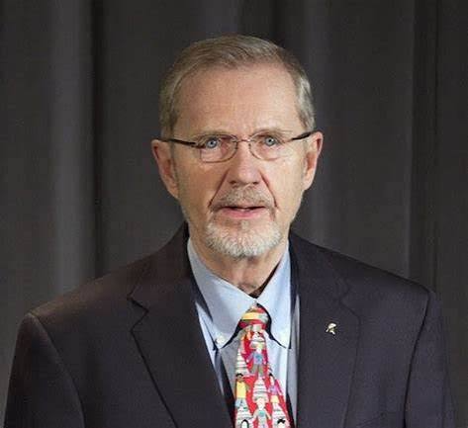
Mayor David Hollister served as Mayor of Lansing, Michigan from 1993 to 2003.
For a community that had built automobiles for nearly a century, GM's departure was almost unimaginable. The company and its workforce were woven into Lansing's identity. Generations of families had earned middle-class livelihoods building Oldsmobiles and other GM vehicles. Thousands more worked for suppliers and local businesses that depended on the plants. Property tax revenue from the factories and workers' homes helped support local school systems. Collectively bargained health care benefits supported doctors, dentists and hospitals throughout the region. The quality of life in Greater Lansing and its ability to attract future businesses were on the line.
Hollister refused to accept GM's decision as inevitable. In 1996, he helped organize the regional Blue Ribbon Committee to Keep GM, bringing together people and institutions that did not always agree. The coalition included city and township governments, business leaders, the United Auto Workers, educational institutions, economic development organizations and community representatives.
The campaign was promoted publicly through the slogans "Keep GM!" and "Lansing Works!" Behind those slogans was a carefully organized effort to demonstrate that Lansing could meet the demands of modern automobile manufacturing.
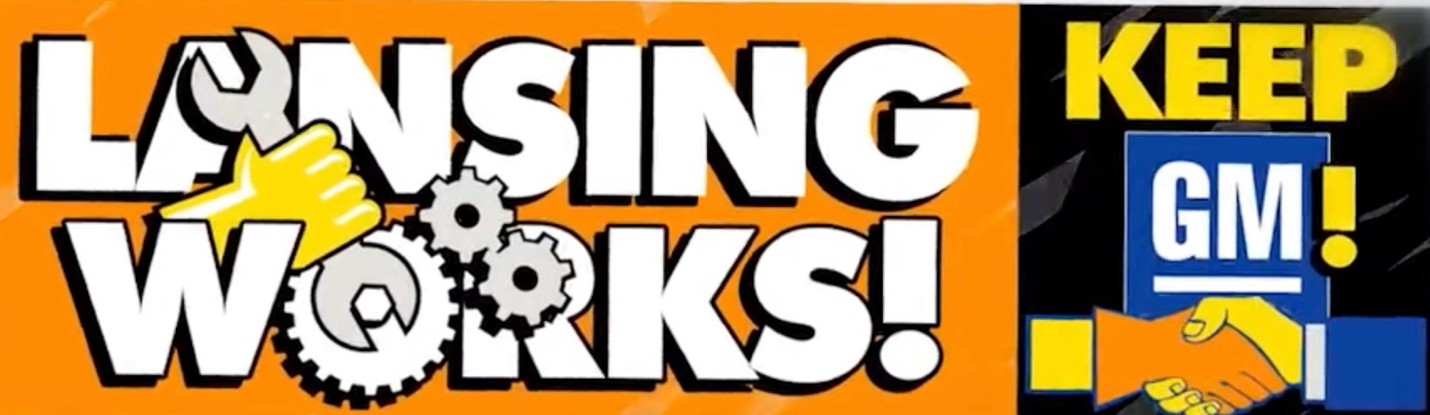
To give the Lansing Works! Keep GM! effort more visibility, this logo was made into bumper stickers and appeared on billboards throughout the Lansing area.
At the time, the automotive industry was undergoing a significant transformation. Automakers were working to adopt their own versions of the Toyota Production System and transition from traditional mass production to lean manufacturing. That transition presented challenges for companies accustomed to older production methods. A skilled workforce was essential, but so was the support of the communities in which those companies operated.
Local government leaders worked across municipal boundaries rather than competing against one another. Business and economic development officials assembled land, infrastructure and financial incentives. Michigan State University and Lansing Community College offered educational and technical support. UAW leaders and GM workers emphasized Lansing's experienced workforce, its record of productivity and its willingness to participate in new manufacturing systems.
That cooperation was crucial. GM was not simply deciding whether to repair an old factory. The company was considering where to invest in an entirely new generation of manufacturing facilities. Lansing was competing against other communities for jobs and investment at a time when automakers were closing older facilities and consolidating production.
One of the first major victories was Lansing Grand River Assembly. Built near downtown Lansing, the plant began producing Cadillac vehicles in 2001. It became an important early example of GM's Global Manufacturing System, which emphasized flexible manufacturing, improved quality, teamwork and greater worker involvement in solving production problems. Its design incorporated advanced manufacturing technologies and production methods intended to improve efficiency and reduce waste.
Another major development was the construction of a new regional stamping facility in Delta Township, which opened in 2004. It was followed by Lansing Delta Township Assembly, which opened in 2006. The new assembly plant incorporated advanced manufacturing technology and environmentally conscious design. Its first products included the GMC Acadia, Saturn Outlook and Buick Enclave. The facility also earned recognition for its environmental design and became an important part of GM's modern manufacturing network.
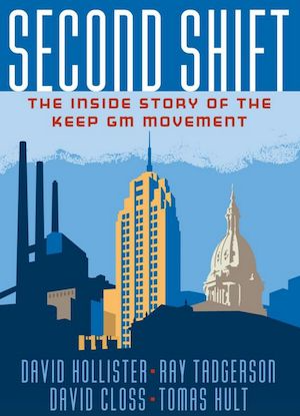
For a behind-the-scenes look at the Keep GM effort—and how Lansing secured two new assembly plants at the beginning of the 21st century—read Second Shift: The Inside Story of the Keep GM Movement.
The Keep GM campaign did not preserve every existing building or every automotive operation. Lansing Car Assembly, the historic complex where automobiles had been produced for more than a century, closed in 2005. The Lansing Metal Center and Lansing Craft Centre also closed in 2006. The Oldsmobile name itself disappeared when GM phased out the brand. The last Oldsmobile, an Alero, rolled off the Lansing assembly line on April 29, 2004.
Nevertheless, the campaign achieved something remarkable. Rather than abandoning the Lansing area, GM invested in two modern assembly plants and a new regional stamping facility. Thousands of manufacturing jobs remained in the region, along with the suppliers, businesses and public services supported by those workers.
Keep GM succeeded because it was more than a promotional campaign or a package of tax incentives. It created a regional coalition around a common goal. Labor, business, education and government recognized that Lansing's automotive future depended on cooperation.
The campaign also demonstrated that Lansing's greatest advantage was not simply its manufacturing history. It was the knowledge, skill and determination of the people who had built vehicles here for generations.
The old factories eventually disappeared from Lansing's landscape, but automobile production did not. The Grand River and Delta Township plants became a bridge between Lansing's Oldsmobile past and its continuing place in the American automobile industry. The Keep GM campaign helped ensure that Lansing would remain what it had been for nearly a century: a community that builds vehicles.
About the Writer
Mark Strolle is an instructor at Michigan State University and a retired United Auto Workers (UAW) representative and labor relations specialist. His affiliation with General Motors (GM) spans over two decades through his extensive work within the UAW-GM partnership. He is also a member of the MotorCities Capital Area Stewardship Community and volunteers at the R.E. Olds Transportation Museum in Lansing.
Bibliography:
Bradsher, Keith. “G.M. and Union Are Near Deal on New Plants.” The New York Times, January 8, 1999.
Delgado, Vince. “Mayor Plans to Send Message to GM.” Lansing State Journal, January 26, 1998.
Hollister, David, Ray Tadgerson, David Closs, and Tomas Hult. Second Shift: The Inside Story of the Keep GM Movement. New York: McGraw-Hill Education, 2016.
Knowledge at Wharton Staff. “How to Keep a Company from Leaving Town.” Podcast transcript, October 26, 2017.
Lacy, Eric. “Lansing’s Effort to Keep GM Emerges as Book.” Lansing State Journal, October 29, 2015.
Martin, Tim. “Two Plants?” Lansing State Journal, January 8, 1999.
Piatt, Gregory. “Group Pools Talent to Keep GM in Lansing.” Lansing State Journal, March 4, 1998.
Rothstein, Jeffrey S. Review of Second Shift: The Inside Story of the Keep GM Movement. Business History Review 91, no. 1 (Spring 2017): 216–218.
Second Shift: From Crisis to Collaboration. Directed by Tom Lietz. Documentary film, 2014.